Character data
禅 chán shàn
Zen; meditation (Buddhism); dhyana (Sanskrit)
#2196
Character data
| HSK | Not in HSK |
| Frequency | 2196th character |
| Radical | ⽰ (113.8) |
| Strokes | 12 |
| Index # | 2793 |
| TRADITIONAL | 禪 |
Definitions
| 禅 chán |
|
| 禅 shàn |
|
Stroke order
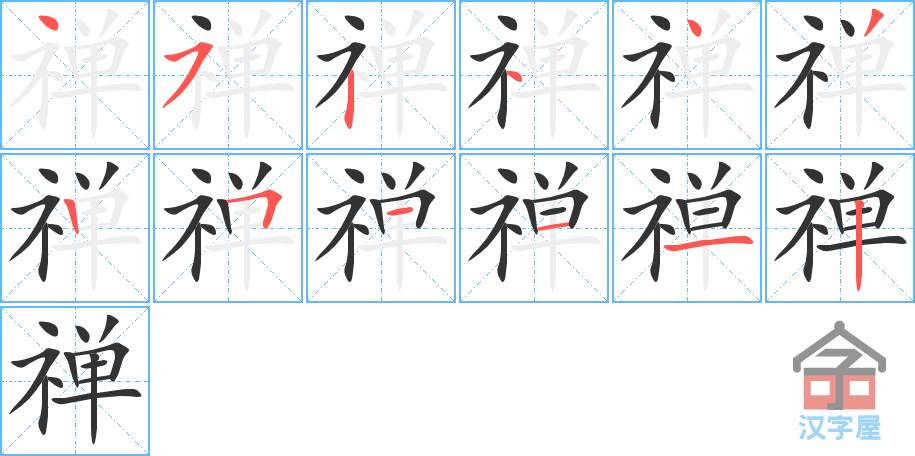
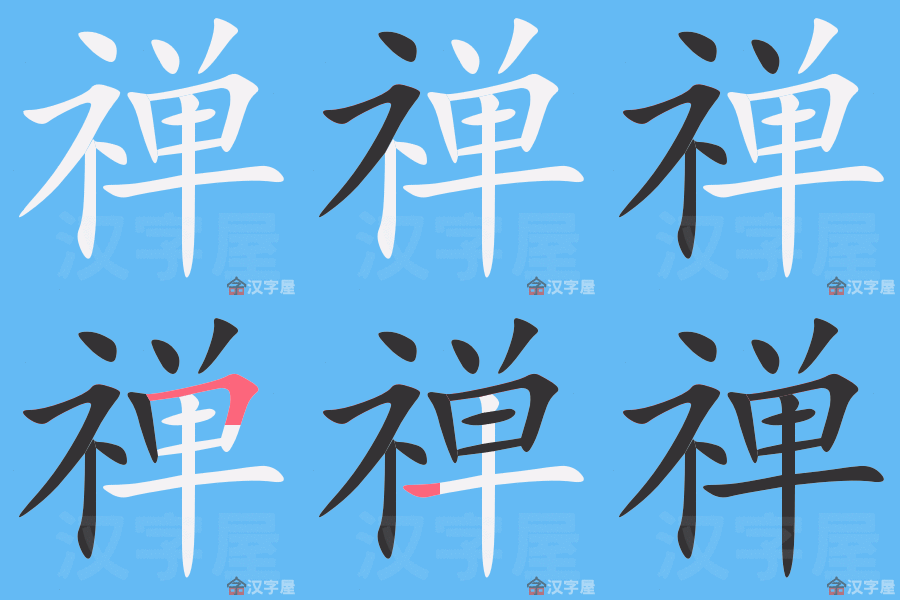
Words containing 禅
| Word | Meaning |
|---|---|
|
favorite expression; (fig.) catchphrase; stock phrase
|
|
|
Zen Buddhism
|
|
|
honorific title for a Buddhist monk
|
|
|
to meditate; to sit in meditation
|
|
|
to practice Zen (esp. meditation)
|
|
|
a room in a Buddhist monastery; a temple
|
|
|
Liu Shan, emperor of Shu Han; Liu Bei’s son
|
|
|
to practice Chan Buddhist meditation; to sit in meditation
|
|
|
to accept abdication
|
|
|
to meditate (of Buddhist)
|
|
|
Yongzhen abdication of 805
|
|
|
Panchen (Lama)
|
|
|
Panchen Lama
|
|
|
abbr. to 班禅bān chán; Panchen Erdeni or Panchen Lama
|
|
|
to abdicate (as king)
|
|
|
see 禅城区chán chéng qū
|
|
|
Chancheng district, Foshan city, Guangdong
|
|
|
meditation room (in Buddhist monastery)
|
|
|
the staff of a Buddhist monk
|
|
|
a Buddhist temple
|
|
|
Buddhism subtleties; Buddhist allegory
|
|
|
to abdicate
|
|
|
the five schools of Chan Buddhism (idiom)
|
|
|
Buddhist hall
|
|
|
Mt Baochan in Anhui; formerly known as Mt Hua 华山huà shān
|